Absence Tracking: Best Methods for UK Businesses (2026 Guide)
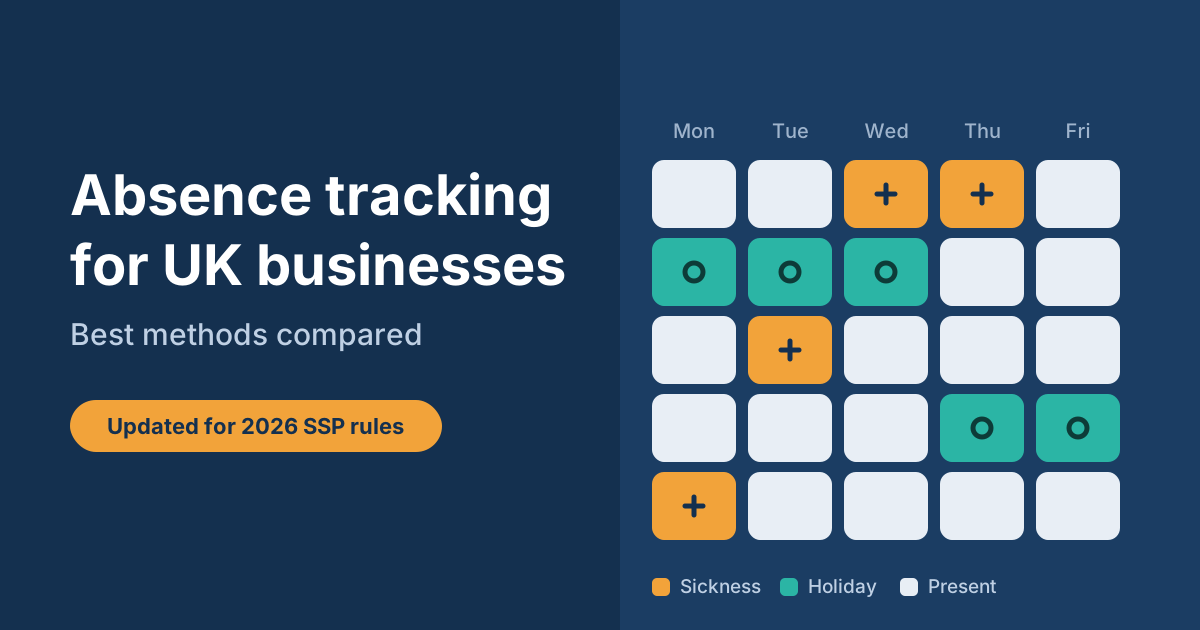
Absence Tracking: Best Methods for UK Businesses
Absence tracking is the process of recording, monitoring and analysing when employees are away from work, whether through sickness, annual leave, family leave or unauthorised absence. For UK businesses it is a legal, financial and people-management issue all at once. Poor records lead to payroll errors, unfair disciplinary decisions and missed signs of burnout.
This guide covers the main absence tracking methods, how they compare, what UK law expects, and how to choose a system that fits your business.
Quick Answer: What Is the Best Way to Track Absence in the UK?
The best way to track absence in the UK is a cloud-based HR or absence management system that records every absence type, calculates Statutory Sick Pay automatically, flags patterns and stores data securely under UK GDPR. Spreadsheets can work for very small teams, but they become risky and time-consuming as headcount grows.
Why Absence Tracking Matters for UK Employers
Legal compliance. Employers must pay Statutory Sick Pay (SSP) correctly, keep accurate records and respect holiday entitlement, including leave that builds up during sickness.
Cost control. Unplanned absence affects productivity, overtime spend and agency cover. You cannot reduce what you do not measure.
Fair, consistent decisions. Accurate data helps managers apply policy equally, which reduces tribunal risk.
Employee wellbeing. Patterns such as repeated short absences or long-term sickness can point to stress, workload problems or health conditions that need support. Some conditions may also be disabilities under the Equality Act 2010, so records should support reasonable adjustments, not just discipline.
Workforce planning. Absence data shows which teams, shifts or seasons need extra cover.
Key UK Rules to Know Before You Choose a Method
Statutory Sick Pay (SSP)
SSP rules changed on 6 April 2026 under the Employment Rights Act 2025. The three unpaid waiting days were abolished and the Lower Earnings Limit was removed, which brought up to 1.3 million low-paid workers into SSP eligibility. For 2026/27 SSP is the lower of £123.25 per week or 80% of average weekly earnings, payable from the first day of sickness for up to 28 weeks. payfitgofile
Your tracking method must therefore capture the first day of absence, qualifying days and average earnings. Always confirm current figures on GOV.UK, because rates are reviewed every April.
Self-Certification and Fit Notes
Employees can usually self-certify for the first seven calendar days of sickness. After that, you can ask for a fit note from a doctor or other healthcare professional. Your system should record these dates and prompt managers when evidence is due.
UK GDPR and Health Data
Sickness records include health information, which is special category data under UK GDPR. You need a lawful basis for processing it, restricted access, a clear retention period and a privacy notice that explains how it is used. Never store absence reasons in an open shared spreadsheet.
Holiday Entitlement
Most workers are entitled to 5.6 weeks of paid annual leave. Leave continues to accrue during sickness, so your tracker should show holiday balances alongside sickness absence.
The Main Absence Tracking Methods Compared
1. Paper Forms and Wall Planners
Best for: Micro-businesses with a handful of staff.
Pros: Free and simple.
Cons: Easily lost, hard to search, no calculations, and a poor fit for GDPR because paper files are hard to secure and audit. Not recommended beyond the smallest teams.
2. Spreadsheets (Excel or Google Sheets)
Best for: Small businesses with fewer than about 20 employees and simple absence rules.
Pros: Low cost, familiar and flexible.
Cons: Manual data entry, formula errors, version-control problems, weak permissions and no automatic SSP calculation. After the April 2026 changes, manual SSP maths is more error-prone.
3. Email and Shared Calendars
Best for: Teams that only need to see who is away.
Pros: Quick visibility.
Cons: Not a record system. Information is scattered, hard to report on and often visible to too many people.
4. Dedicated Absence Management Software
Best for: Businesses that want focused absence and leave tracking without a full HR suite.
Pros: Self-service requests, approval workflows, automatic balances, absence reports and trigger alerts.
Cons: May need integration with payroll or HR tools.
5. Full HRIS and Payroll Integration
Best for: Growing SMEs and larger employers.
Pros: One employee record, automatic SSP calculation, direct payroll feed, strong reporting and audit trails.
Cons: Higher cost and a longer setup time.
6. Time and Attendance Systems
Best for: Shift-based sectors such as retail, hospitality, healthcare, logistics and manufacturing.
Pros: Clock-in data shows lateness and no-shows in real time. Rota tools can find cover quickly.
Cons: Needs clear policies on how attendance data is used, especially if biometric clocking is involved.
Comparison Table
| Method | Cost | Accuracy | GDPR Security | SSP Support | Best For |
|---|---|---|---|---|---|
| Paper forms | Very low | Low | Poor | None | Micro teams |
| Spreadsheets | Low | Medium | Weak | Manual | Under 20 staff |
| Email/calendar | Low | Low | Weak | None | Visibility only |
| Absence software | Medium | High | Strong | Often built in | SMEs |
| HRIS + payroll | Medium–high | Very high | Strong | Automatic | Growing firms |
| Time and attendance | Medium | High | Varies | Via integration | Shift work |
Absence Metrics Worth Tracking
Recording absence is only the start. Useful measures include:
- Absence rate: Days lost as a percentage of total working days.
- Frequency: How often employees are absent, not only for how long.
- Short-term vs long-term absence: These need different management approaches.
- Absence by team, site or shift: Highlights local management or workload problems.
- Absence by day of the week: Frequent Monday or Friday absence may need a conversation.
- Cost of absence: SSP, sick pay top-ups, cover and lost output.
The Bradford Factor
The Bradford Factor scores absence patterns with the formula B = S² × D, where S is the number of separate absence spells and D is the total days absent in a period, usually 52 weeks. It highlights frequent short absences, which tend to disrupt operations most.
Use it carefully. Applied rigidly, it can disadvantage employees with disabilities or long-term conditions, and pregnancy-related absence should be excluded. Treat it as a prompt for a supportive conversation, not an automatic trigger for discipline.
Best Practice for UK Businesses
1. Write a clear absence policy. Explain how and when to report absence, who to contact, what evidence is needed and how pay is handled. Include the difference between SSP and any company sick pay.
2. Use one central record. Avoid parallel trackers held by individual managers.
3. Hold return-to-work conversations. Brief, consistent meetings after every absence help spot problems early and show you are taking wellbeing seriously.
4. Separate recording from judging. Collect data consistently, then review each case on its merits, including any health or disability considerations.
5. Restrict access. Only HR and the relevant line manager should see absence reasons.
6. Automate SSP and holiday calculations. This reduces underpayment risk and saves payroll time.
7. Review data monthly. Look for trends before they become costly problems.
8. Support wellbeing. Offer employee assistance programmes, flexible working options and occupational health referrals where appropriate.
How to Choose the Right Absence Tracking System
Ask these questions before you buy:
- Does it calculate SSP under the 2026/27 rules?
- Can employees request and report absence from a mobile phone?
- Does it integrate with your payroll software?
- Can you set custom absence types, such as sickness, TOIL, carers’ leave and parental leave?
- Does it support multiple sites or shift patterns?
- Are role-based permissions and audit logs included?
- Is data stored in the UK or EU, and is the supplier UK GDPR compliant?
- Does reporting include Bradford Factor and trend analysis?
- Is the price clear as your headcount grows?
Request a demo and test it with your own scenarios, such as a part-time worker, a zero-hours worker and an absence that crosses a pay period.
Common Absence Tracking Mistakes
- Using a spreadsheet long after the business has outgrown it
- Applying the Bradford Factor without considering disability or pregnancy
- Recording health details in places too many people can see
- Forgetting that holiday keeps accruing during sickness
- Calculating SSP with outdated rules
- Failing to follow up on repeated short absences
- Treating tracking only as a disciplinary tool
Frequently Asked Questions
What is absence tracking?
Absence tracking is the recording and analysis of employee time away from work, including sickness, holiday and other leave, to support payroll, compliance and workforce planning.
Is it a legal requirement to track employee absence in the UK?
There is no single rule that says “track absence,” but employers must keep accurate records to pay SSP and holiday pay correctly, comply with working time rules and show fair treatment if challenged.
How much is Statutory Sick Pay in the UK?
For 2026/27, SSP is the lower of £123.25 per week or 80% of average weekly earnings. It is payable from the first day of sickness. Check GOV.UK for the latest figures.
How long can an employee self-certify?
Normally for the first seven calendar days. After that, an employer can request a fit note.
What is a good absence tracking system for small businesses?
Small UK businesses often start with a spreadsheet, then move to a cloud HR or absence tool once staff numbers grow or SSP calculations become complex.
Can employers record the reason for sickness absence?
Yes, but it is health data. Record only what is necessary, keep it secure and limit access.
Is the Bradford Factor legal?
Yes, but it must be used fairly. Adjustments may be needed for disability-related or pregnancy-related absence.
Conclusion
Effective absence tracking helps UK businesses stay compliant, control costs and support their people. Spreadsheets may do for a very small team, but with SSP rules now more complex, most growing businesses benefit from software that automates calculations, protects data and highlights patterns early.
Start by reviewing your current process, update your absence policy for the April 2026 SSP changes, and choose a system that fits your size and sector.